 Pacoca
 portfolio tracking brought supported DeFi investments together in one dashboard
Updated -
Pacoca portfolio tracking grouped supported DeFi investments into a single wallet-based dashboard. The early tracker centered on BNB Smart Chain, with visibility tied to supported projects. Reading holdings differed from depositing or withdrawing assets. Later messages attributed to Pacoca announced closure; current dashboard access remains unconfirmed.
Bottom line: Portfolio values can change with token prices even when the quantities held in the underlying positions remain unchanged.
A public address opened the consolidated view
The original tracker accepted a public wallet address and displayed investments within its supported integrations. Its browser flow separated an address lookup from features that created blockchain transactions. Viewing identified the wallet to inspect; harvesting or swapping required a wallet connection. The output concerned existing investments associated with the address, including positions in other DeFi projects.
Existing investments could appear without a preliminary deposit into a Sweet Vault.
Wallet balances and protocol positions needed separate interpretation
The dashboard’s June 2022 scope included token holdings, staking, lending, borrowing, harvestable rewards and NFTs. An amount available in a wallet and a claim on assets deposited elsewhere could represent different stages of an investment.
Wallet balances and deposited assets
A wallet token balance described holdings at that address. A deposited position concerned assets committed through a protocol’s contracts. Reading only the wallet balance could therefore omit investments elsewhere. Conversely, adding the same deposited assets and the token representing that deposit could count one exposure twice. A portfolio reconciliation needs to identify what each entry represents before treating every displayed amount as an additional holding.
LP farming and underlying tokens
LP farming details included the quantities and values of tokens inside liquidity-pool positions, often called LP positions. An LP token represented participation in a pool. Its underlying token breakdown explained the exposure within that position. Counting both the full LP valuation and its component values as separate investments would duplicate that exposure.
Did a BNB Smart Chain address establish complete tracking coverage?
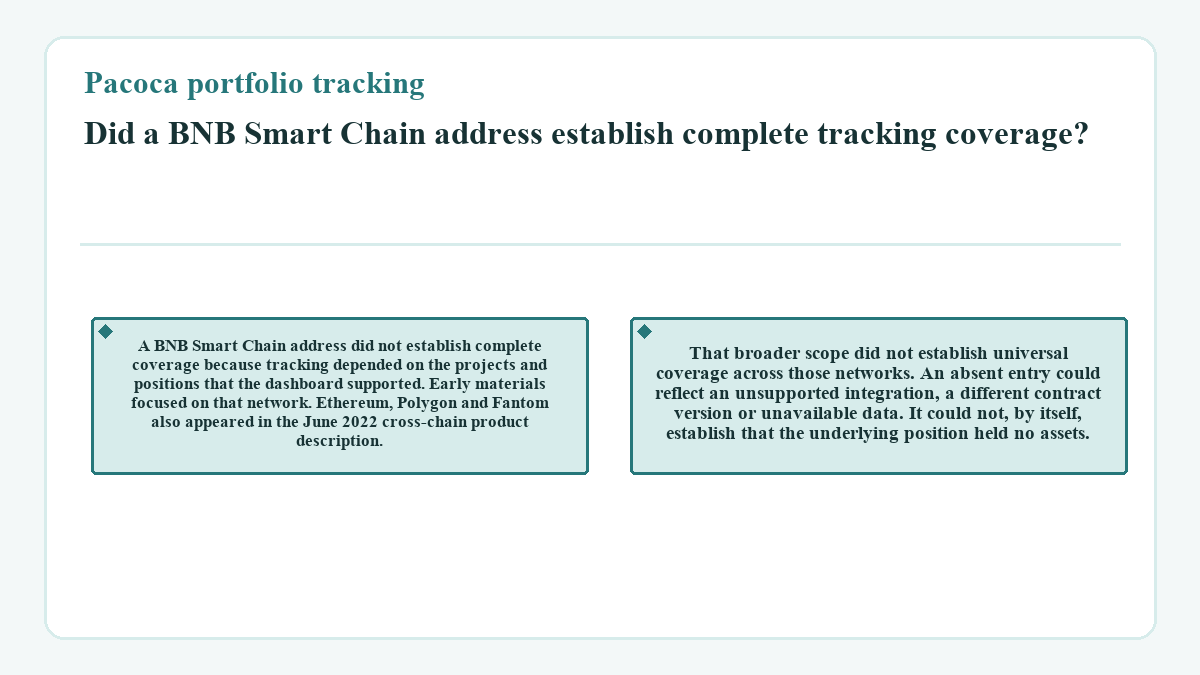
A BNB Smart Chain address did not establish complete coverage because tracking depended on the projects and positions that the dashboard supported. Early materials focused on that network. Ethereum, Polygon and Fantom also appeared in the June 2022 cross-chain product description. That broader scope did not establish universal coverage across those networks. An absent entry could reflect an unsupported integration, a different contract version or unavailable data. It could not, by itself, establish that the underlying position held no assets.
Token quantities and market values answered different questions
A token quantity described how much of an asset a position contained, while its monetary value depended on the price used for that valuation. Price movements could change the total while quantities remained unchanged. Deposits, withdrawals and accumulated rewards could change quantities as well.
Comparisons need the same asset denomination and a consistent point in time. PACOCA rewards and a deposit in another token need a common valuation currency before their values can be combined. Likewise, a quoted portfolio value describes a valuation, not necessarily the proceeds that a sale or withdrawal would produce. The position’s composition and applicable transaction conditions still determine that outcome.
V2 valuations needed to account for PACOCA rewards
The August 12, 2021 V2 Sweet Vault design separated the original deposit from rewards that the strategy converted into PACOCA.
The original deposit
The vault placed the deposited tokens or LP tokens in an external farming contract. Tracking that investment therefore required recognizing a position beyond the wallet’s ordinary token balance. A stable quantity of deposited assets did not imply a stable monetary value, because those assets retained their own market exposure. The deposited position and its accumulated rewards needed distinct treatment.
Rewards in Auto PACOCA
The V2 strategy claimed farming rewards, converted them into PACOCA and deposited those rewards in Auto PACOCA. A portfolio interpretation therefore needed to preserve both the reward token and its invested state. When the deposit used another asset, counting reward growth as more units of that deposit would misidentify the token. Vault fees also affected net earnings; a balance display alone did not explain the deductions behind a reward amount.
Was the portfolio total the same as realized profit?
A portfolio total represented a valuation, while realized profit required acquisition costs, cash flows, completed disposals and applicable fees. An increase after a deposit could reflect additional capital. A decrease after a withdrawal could reflect assets leaving the tracked positions. Neither movement alone established investment performance. Outstanding borrowing also differed from an owned asset. A holdings snapshot could help identify the portfolio’s composition without supplying the full history needed to calculate its return.
Historical portfolio views did not establish current access
Later messages attributed to Pacoca announced project closure and described a period of platform inactivity. Current access to the portfolio tracker remains unconfirmed. Historical dashboard descriptions therefore explain how the product worked during its documented operation. They do not establish an available service today, an active list of integrations or a functioning path to every old position.
A previously saved portfolio view can still identify an address, an asset or a protocol that needs further examination. Its displayed amounts retain the time scope of that record. A token price listing elsewhere does not establish that Pacoca’s dashboard operates, and an old dashboard balance does not establish a current withdrawal amount. Portfolio visibility and access to deposited assets are separate questions.
Why did some BabySwap-linked Sweet Vault withdrawals fail?
On February 2, 2023, Pacoca reported that withdrawals from Sweet Vaults staking in BabySwap’s V1 Masterchef failed because that contract had lost minting rights.
BabySwap had transferred ownership of its token contract, including minting rights, from its V1 Masterchef to V2. The V1 withdrawal function attempted to mint tokens. That call failed after V1 lost the required authority, which caused the withdrawal transaction to fail.
Pacoca’s immutable vault contracts depended on that underlying function. A dashboard could describe a position without repairing the contract call needed to release it.
The V1 and V2 labels in this incident referred to BabySwap’s farming contracts, distinct from Pacoca’s own vault versions.
The report described possible remedies that required BabySwap’s action. It did not announce a completed recovery or establish a later outcome.
A public wallet view still revealed financial activity
Address-based tracking drew on public blockchain information. An address could reveal holdings and protocol activity without revealing the private key that controlled them. Sharing a portfolio screenshot with an identifiable address could associate that financial activity with a person. The privacy consequence came from linking an identity to public records, even when the lookup itself required no transaction.
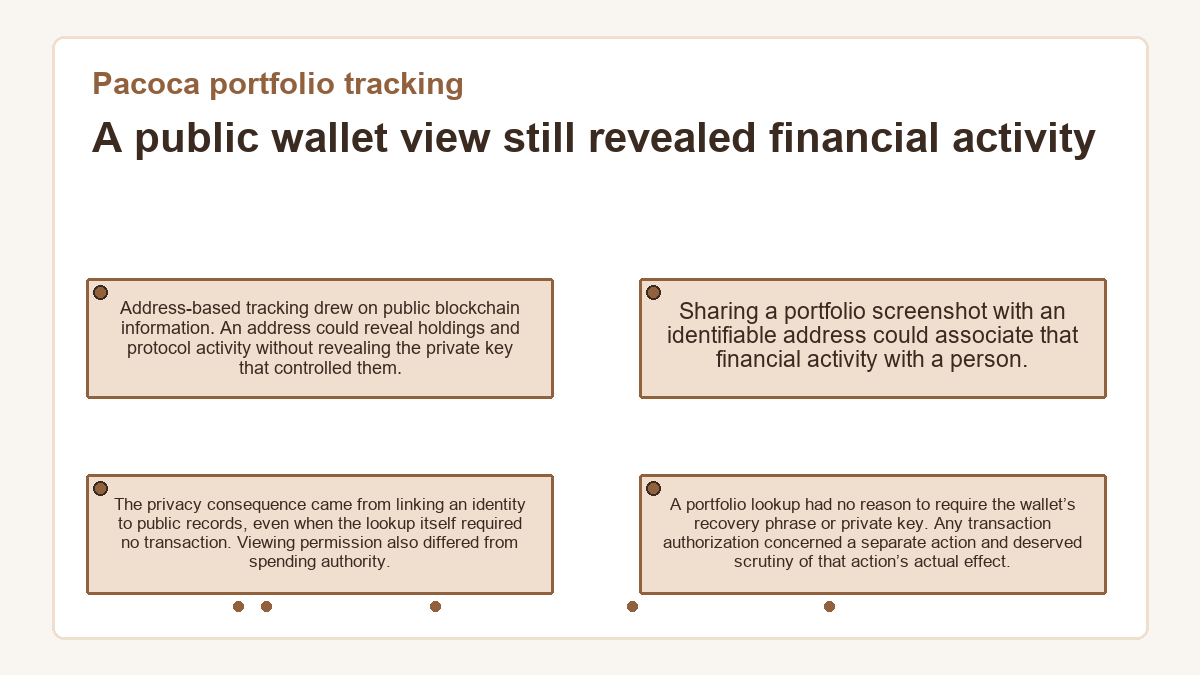
Viewing permission also differed from spending authority. A portfolio lookup had no reason to require the wallet’s recovery phrase or private key. Any transaction authorization concerned a separate action and deserved scrutiny of that action’s actual effect.
Reconciling a portfolio view before changing a position
When deciding whether a consolidated view answers an existing holdings question, compare it with the underlying position records using the same address and network. The dashboard offered convenience across supported projects; individual position records supplied the detail needed to investigate a discrepancy. Begin with inspection before considering any transaction that changes the investment.
- Match the wallet address and network across the records.
- Identify the protocol and contract version behind each deposited position.
- Distinguish wallet holdings from deposits and any outstanding borrowing.
- Record each reward in its actual token denomination and distinguish claimable rewards from rewards already staked.
- Reconcile token quantities before interpreting differences in monetary values.
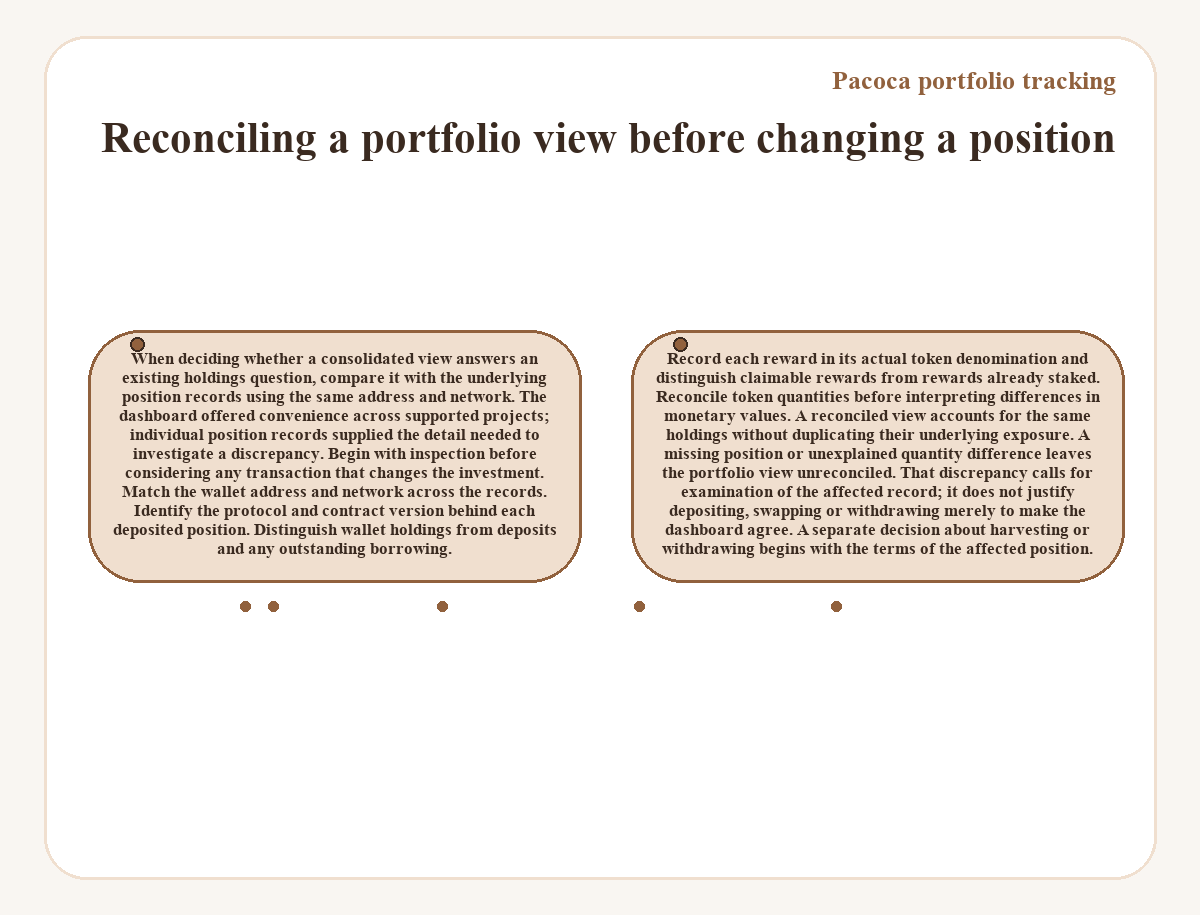
A reconciled view accounts for the same holdings without duplicating their underlying exposure. A missing position or unexplained quantity difference leaves the portfolio view unreconciled. That discrepancy calls for examination of the affected record; it does not justify depositing, swapping or withdrawing merely to make the dashboard agree. A separate decision about harvesting or withdrawing begins with the terms of the affected position.
Pacoca portfolio tracking - common questions
Would opening a wallet view create a gas charge?
Reading public blockchain data does not itself submit a transaction or consume gas from the viewed wallet. Pacoca separated address-based tracking from its transaction functions. Harvesting, swapping or moving funds involved an on-chain action with its own transaction cost.
Could the tracker display a portfolio in a mobile browser?
The original address-lookup design supported mobile and desktop browsers. Creating blockchain transactions required a compatible wallet connection, separate from opening the portfolio view.
How often did Pacoca refresh portfolio balances?
The May 21, 2021 design described real-time updates without specifying a fixed refresh interval. That wording supplied no guaranteed deadline for the dashboard to reflect a completed blockchain transaction.
Which contract distinction matters when comparing old Pacoca V1 and V2 entries?
Pacoca’s August 12, 2021 migration guide described moving investments to a new V2 vault contract. Historical V1 entries and later V2 entries therefore need their respective dates and contract identities. Their appearance in separate records alone does not establish that the wallet held both balances simultaneously.
Were liquidation notifications part of the original tracking roadmap?
The May 21, 2021 roadmap listed liquidation notifications for lending applications as planned work. That entry did not establish an active alert service or promise a warning before liquidation.
Does an LP valuation measure impermanent loss?
An LP valuation alone does not measure impermanent loss, which compares a liquidity position with holding its underlying assets over the same period. Pacoca’s May 21, 2021 roadmap listed an impermanent-loss calculation feature as planned work. A visible LP balance did not establish that feature’s availability.
Is a Pacoca screenshot proof that someone controls the displayed wallet?
A Pacoca screenshot does not prove that its viewer controls the displayed wallet. A public address reveals no signing authority, so a visible balance alone cannot establish ownership or permission to move assets.