 Pacoca
 combined portfolio tracking with token swaps and Sweet Vaults
Updated -
Pacoca was a decentralized finance (DeFi) hub for portfolio tracking, token swaps and yield aggregation through Sweet Vaults. Its early tracker focused on BNB Smart Chain, while the vaults placed deposits in external farming strategies. Later products included dollar-cost averaging and Sweet Bonds. A later message attributed to the project announced closure. Current access to individual vaults and recovery services remains unconfirmed.
Portfolio tracking brought supported DeFi positions together
A combined portfolio view let users follow assets across supported DeFi projects. Tracking concerned information about positions; investing in a Sweet Vault involved assets entering a particular strategy. The tracker provided a view of the portfolio as a whole, including holdings outside the platform’s own vaults.
The early tracker focused on BNB Smart Chain, historically called Binance Smart Chain. Support for tracking a position established a display capability. Swapping that asset or investing it in a vault involved a separate function, with its own product scope.
Token swaps complemented the portfolio view
DEX aggregation provided the token-exchange component of the hub, alongside its consolidated view of DeFi assets. A decentralized exchange, or DEX, enables token trading through blockchain-based markets. The aggregator function concerned exchange routes, while a portfolio display concerned existing assets and positions. Neither function, by itself, described how a Sweet Vault invested funds.
A swap quote and a vault return also measured different things. The quote concerned an exchange between assets; the return concerned earnings from a strategy over time. A fee quoted for one activity could not establish the cost of the other.
Where did V2 Sweet Vault rewards go?
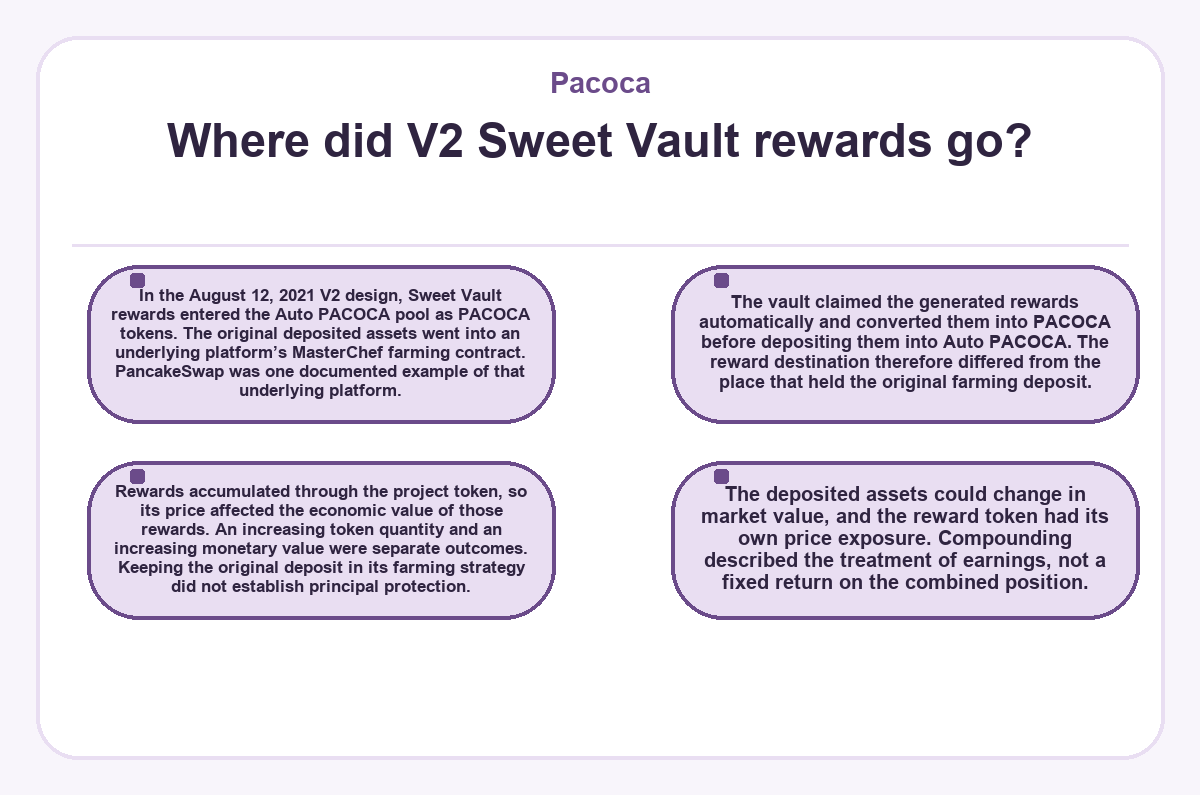
In the August 12, 2021 V2 design, Sweet Vault rewards entered the Auto PACOCA pool as PACOCA tokens.
The original deposited assets went into an underlying platform’s MasterChef farming contract. PancakeSwap was one documented example of that underlying platform. The vault claimed the generated rewards automatically and converted them into PACOCA before depositing them into Auto PACOCA. The reward destination therefore differed from the place that held the original farming deposit.
Rewards accumulated through the project token, so its price affected the economic value of those rewards. An increasing token quantity and an increasing monetary value were separate outcomes.
Keeping the original deposit in its farming strategy did not establish principal protection. The deposited assets could change in market value, and the reward token had its own price exposure. Compounding described the treatment of earnings, not a fixed return on the combined position.
Reading an unchanged deposit alongside growing rewards
Consider a hypothetical historical V2 position with unchanged units of the deposited asset and additional PACOCA rewards. Does the unchanged deposit mean that compounding failed?
Those observations fit a design that compounded converted rewards separately from the underlying deposit. An unchanged deposit quantity alone would not show a failed compound, because that balance was not the destination for converted earnings.
Additional PACOCA rewards alone would not establish a monetary gain for the combined position. Prices and the applicable fees would still affect that outcome.
What did Chainlink Automation automate?
Chainlink Automation triggered the vault functions that supported automatic compounding, reducing the need for users to initiate each compound manually. Smart contracts require an external transaction to run such functions. An automation service monitors the relevant execution conditions and submits a transaction when those conditions call for it.
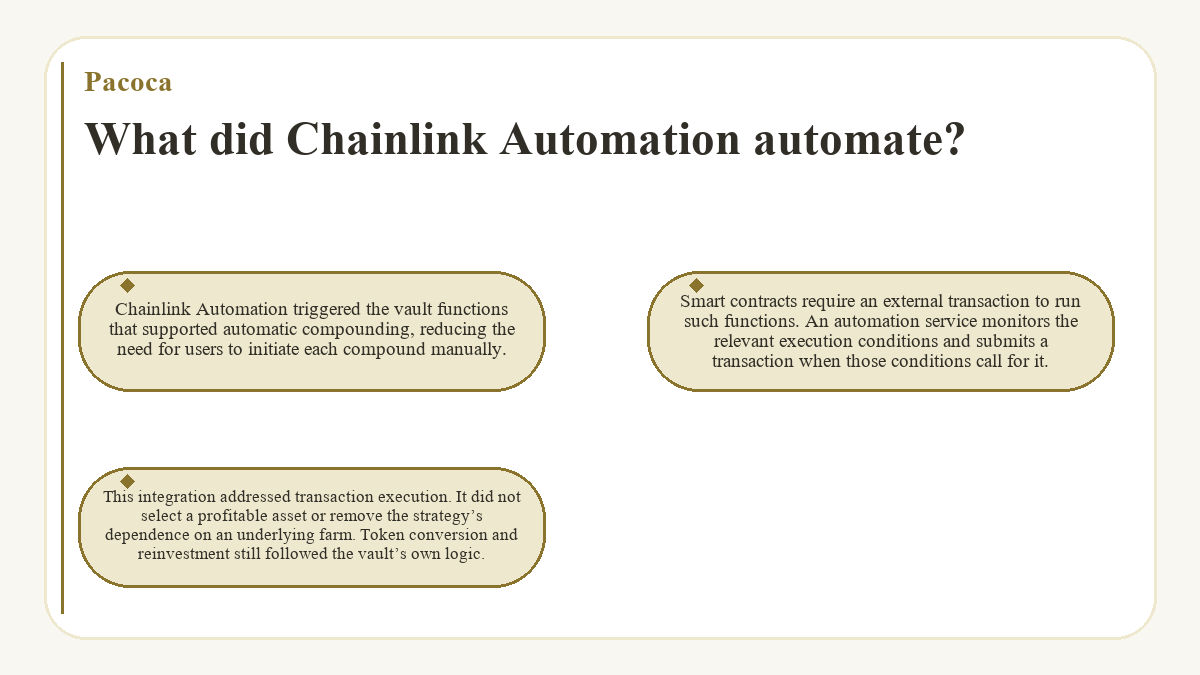
This integration addressed transaction execution. It did not select a profitable asset or remove the strategy’s dependence on an underlying farm. Token conversion and reinvestment still followed the vault’s own logic.
Profit fees and early withdrawals used different bases
The August 12, 2021 V2 fee schedule distinguished charges on profits from a charge on an early withdrawal. It listed 3.0% of profits for a planned pool intended to reward PACOCA stakers with BNB. It allocated another 0.5% of profits to the keeper. The schedule separately listed a 1% withdrawal fee within three days of deposit.
The profit charges applied to profits, rather than to the entire deposited balance. The withdrawal charge had a different trigger: elapsed time since deposit. These were historical V2 terms. They do not establish a fee schedule for another vault version or for a token swap.
The V1 transition moved deposits to a new contract
The 2021 transition required holders of V1 vault deposits, including V1 Sweet Vaults, to move into V2. The migration guide specified the order: withdraw the deposited tokens or liquidity-pool tokens, approve the new V2 contract and deposit into V2. Approval authorized token access for the new contract; it did not itself place assets in the new vault.
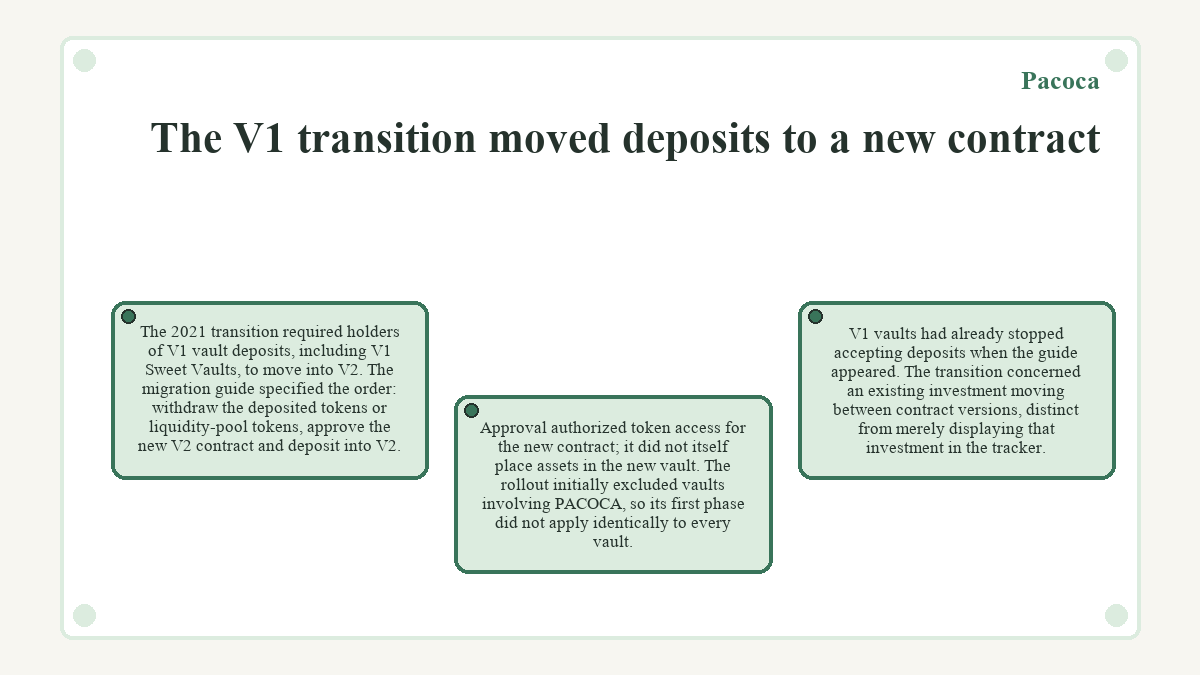
The rollout initially excluded vaults involving PACOCA, so its first phase did not apply identically to every vault. V1 vaults had already stopped accepting deposits when the guide appeared. The transition concerned an existing investment moving between contract versions, distinct from merely displaying that investment in the tracker.
DCA and Sweet Bonds extended the investment functions
The product family later expanded beyond tracking and auto-compounding. March 2023 product updates covered Sweet Bonds; October 2023 updates covered dollar-cost averaging (DCA). DCA spreads purchases over time. The project presented Sweet Bonds as token exchanges at discounted prices under the terms of the individual offering.
These products addressed different choices from harvesting farm rewards. A purchase schedule governed repeated acquisition, while a bond’s terms governed its exchange offer. Their shared branding did not make the V2 vault’s profit fee or early-withdrawal rule apply automatically to either product.
Why did underlying farm contracts matter?
Underlying farming contracts controlled functions that Sweet Vaults needed, including the path for withdrawing deposited assets.
The project’s February 2, 2023 BabySwap incident report described a dependency failure. BabySwap had moved minting rights from its V1 MasterChef to V2. Its old withdrawal function then failed when it attempted to mint tokens. Sweet Vaults that staked through that V1 contract consequently could not withdraw through the affected function at that time.
The problem concerned a particular underlying contract and its migration. Automatic compounding and successful withdrawals were different capabilities. Running a keeper could not repair minting permissions that another protocol controlled.
For an existing position, the next question concerns the underlying contract that holds the assets and whether its withdrawal functions still work.
Quick answers about Pacoca
Which fee waiver applied to the old V1 vaults?
The August 12, 2021 migration guide waived withdrawal fees for all V1 vaults, including V1 Sweet Vaults. That waiver concerned the old vault version during the transition. It did not replace the separately stated V2 withdrawal terms or establish a permanent waiver for later products.
Did the V1 migration require breaking apart liquidity-pool tokens?
The 2021 migration guide said that users did not need to unwind their liquidity-pool tokens. Its process moved the deposited tokens from the old vault into V2 after approval of the new contract. That historical procedure does not establish that the same migration interface remains available.
How long did the original V1 migration window last?
The August 12, 2021 guide described migration to V2 without a time limit. It separately scheduled the end of V1 rewards for August 19, 2021. Continued migration eligibility and continued reward generation were different conditions. The historical window does not confirm present access to migration tools.
Was the migration airdrop a permanent PACOCA reward?
The migration airdrop was a dated transition incentive, not a standing reward. The August 2021 guide announced $5 in PACOCA for migrating from V1 to V2, with distribution scheduled for August 23, 2021. That announcement did not establish that every eligible user ultimately received a payment.
Does a PACOCA price chart establish that the app is operating?
A PACOCA price chart describes token market data, not the operating status of the former app. A quoted price does not establish available vault deposits, functioning withdrawal tools or executable liquidity for a particular trade.
Was BNB Smart Chain the network for every announced product?
The early tracker focused on BNB Smart Chain, while a March 13, 2023 anniversary announcement also named an Arbitrum DEX. Those references do not establish identical swap routes or vault support across networks. Network scope belongs to the particular product and version, rather than to the project name alone.